
RSUD Langsa EMR
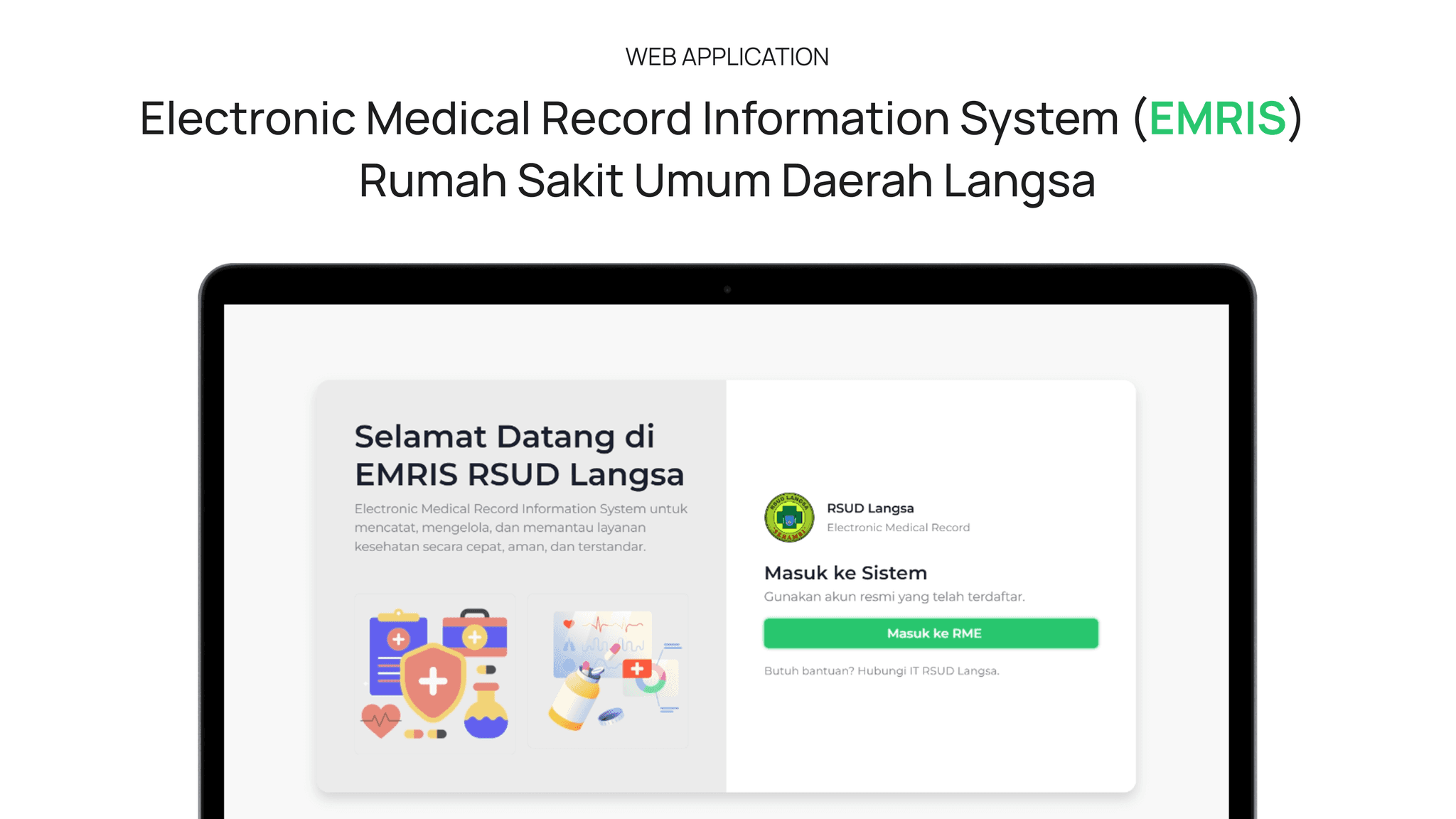
An Electronic Medical Record system replacing RSUD Langsa's paper archive across 7 clinical units. Promoted to lead the project after a year on it, coordinating 8+ developers with 1,446 commits as the top contributor.
- Project Duration
- Sep 2025 - Aug 2026
- Role
- Project Lead
Overview
The RSUD Langsa EMR is an electronic medical record system that replaces the hospital's entire paper archive, running across 7 clinical units: Inpatient, Outpatient, Emergency, Central Surgery (OR), Hemodialysis, Medical Rehabilitation, and Forensics. It covers the full clinical flow from initial assessment and daily inter-professional progress notes to cross-unit orders, medical resumes, and patient discharge. I joined as a Junior Developer, building the Digital Records module and cross-unit integrations from scratch, then was promoted to Project Lead as the system grew to 7 units with 8+ developers.
Challenges
The hospital was still entirely paper-based, with dozens of clinical and legal document types that had to go digital without disrupting how nurses and doctors already worked. Technically, the system had to sit on top of a live legacy hospital information system database, while the early codebase was full of scattered ad-hoc queries that let patient data drift out of sync between units. The team grew quickly to 8+ developers with no commit conventions and not a single automated test - on data that simply cannot be wrong.
Solution
I led the transition from ad-hoc queries to a structured service-layer architecture, with centralized patient-context resolvers so visit, transaction, and episode data stay consistent across every unit. I introduced automated testing to a codebase that had none (writing 13 of 16 test files myself), along with commit conventions and a review flow the whole team now follows. Across the project I reviewed and integrated 264 merges from 8+ developers, handled a production data-loss incident through to full recovery with no permanent loss, and authored architecture and rollout/rollback documentation so high-risk clinical modules could be migrated safely.
Key Features
- Specialty-specific medical & nursing assessments (pediatric, obstetric, geriatric, psychiatric, neonatal, dermatovenereology, terminal, pre-operative)
- Integrated inter-professional progress notes (SOAP) with vital signs, diagnoses, and care-team instructions
- Clinical risk scoring: Morse, Humpty Dumpty, geriatric scales, and adult/pediatric/obstetric EWS
- Digital Records: ~25 clinical and legal document types (informed consent, DNR, service deferral) with digital signatures
- E-prescribing and pharmacy orders, including discharge prescriptions
- Cross-unit orders: radiology (PACS), laboratory, surgery (OR), hemodialysis, medical rehabilitation, specialist consultation, and blood transfusion
- Patient monitoring: fluid balance, ICU/NICU/PICU/ICCU observation, nutrition monitoring, and patient transport supervision
- Patient management: inter-ward transfers, medical resumes, and discharge workflows
- Role-based access control, activity logs, per-unit reports, and BPJS insurance bridging